


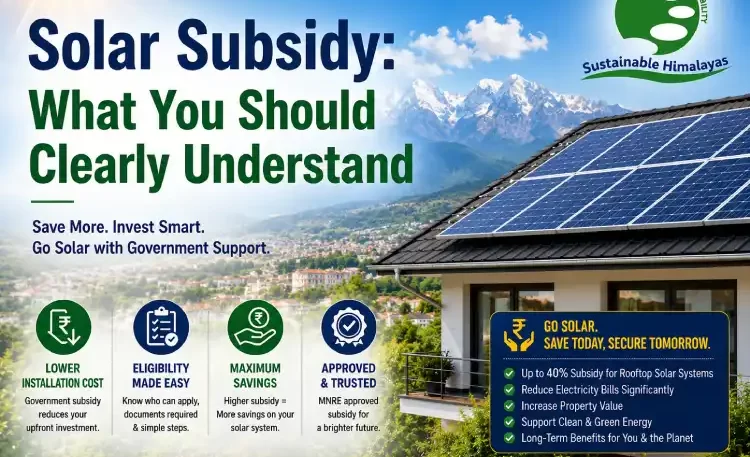
Government subsidy is one of the biggest advantages available to you, but it’s also an area where confusion runs high. Let’s break down exactly how subsidies work, what you can expect, and the right questions to ask before you invest — because this benefit is valid only till March 31, 2027.
Why the Government Offers Solar Subsidies
The Government of India actively promotes rooftop solar through programs like the PM Surya Ghar Muft Bijli Yojana to:
- Reduces electricity expenses of household
- Boost adoption of clean energy
- Reduce dependence on fossil fuels
- Boost domestic solar manufacturing companies
- Country meet renewable energy targets
The subsidies make solar systems more affordable for people. It helps homeowners recover their investment faster.
Subsidy Breakdown: What You’ll Actually Receive
The Central Government provides financial assistance for residential rooftop solar installations under the PM Surya Ghar Muft Bijli Yojana.
Central Subsidy for a 3kW System:
- Uttarakhand: Up to ₹85,800 Central Subsidy
- Other States: Central Subsidy is available as per the applicable government guidelines and state-wise provisions.
- Subsidy is available only for residential rooftop solar systems installed through approved vendors.
- The subsidy amount is credited directly to the beneficiary’s bank account after successful installation and inspection.
- The scheme aims to promote clean energy adoption and reduce household electricity expenses.
- Eligibility and subsidy disbursement are subject to the latest government regulations.
Example:
If a 3kW rooftop solar system costs ₹1,75,000 and you are eligible for a subsidy of ₹85,800, your effective investment may reduce to approximately ₹89,200.
Savings Potential:
. Generate your own electricity from solar energy.
. Reduce dependence on grid power.
. Long-term savings on monthly electricity bills.
- ii) State Subsidy (Available in Selected States)
Some state governments provide additional benefits over and above the central subsidy:
- Uttar Pradesh – Additional state subsidy for eligible residential solar installations
● Delhi – Additional subsidy on top of central government schemes
● Haryana – State incentives for residential rooftop solar systems
● Bihar – Additional state support for eligible solar consumers
● Note: State subsidy policies are subject to change. Please check with the respective state’s renewable energy department for the latest guidelines and eligibility criteria.
State subsidies vary significantly because each state has its own renewable energy targets and budget allocations. Benefits may include:
- Extra financial assistance
- Reduced approval fees
- Net metering incentives
- Accelerated processing
How Much Will the Government Actually Pay?
Combined Subsidy Contribution (Indicative Figures)
Normal States (Haryana, Delhi, etc.):
- Central Government: 25%–35%
- State Government: 0%–20% (where applicable)
- Your Contribution: 50%–75%
Hilly States (Uttarakhand, Himachal Pradesh, etc.):
- Central Government: 30%–40%
- State Government: Additional support (if available)
- Your Contribution: 40%–70%
Example for a 3kW System in Normal Areas:
- Total System Cost: ₹2,00,000
- Central Subsidy: ₹78,000
- State Subsidy (if applicable): ₹20,000–₹30,000
- Your Cost: ₹92,000
Important Clarifications: How Subsidies Are Actually Credited
✓ Subsidy Timing
- Subsidy is credited AFTER installation and net metering is complete
- It does not reduce your upfront cost
- You pay the full system cost first, then receive reimbursement
✓ Direct Disbursement
- Subsidy comes directly to the homeowner’s bank account
- Not deducted from your invoice by the installer
- Processed by the government after approval
✓ Installer Requirements
- The installer must be MNRE-empanelled (approved by the Ministry of New and Renewable Energy)
- Only certified installers can process subsidy applications
- Working with non-certified companies may disqualify you from subsidy benefits
✓ Net Metering Requirement
- Subsidy applications require net metering installation with the local electricity board
- Your electricity company connects the system and enables net metering
- This process must be completed before subsidy disbursement
Common Misconceptions You Should Avoid
Myth 1: Government subsidies make solar systems completely free.
- Reality: Subsidies reduce costs significantly but homeowners still contribute 40%–75% of the total cost.
Myth 2: Any solar company can process subsidies.
- Reality: Only MNRE-empanelled installers can handle subsidy applications. Working with non-certified companies may disqualify you.
Myth 3: You’ll receive subsidy money before installation.
- Reality: Subsidy is credited after installation, net metering, and government approval—typically 2–4 months after system activation.
Myth 4: Commercial and residential subsidies are the same.
- Reality: Commercial and industrial projects follow different policies and rarely qualify for residential subsidy schemes.
Critical Verification Checklist: Questions to Ask Your Solar Company
Before signing any contract, ask these questions:
✓ Subsidy Management
- Will the company handle the entire subsidy application process?
- Are you MNRE-empanelled and authorized to process subsidies?
- What documents will you need from me?
✓ Net Metering
- Who manages net metering with the electricity board?
- Will the company coordinate with the distribution company?
- What is the expected timeline for net metering approval?
✓ Subsidy Timeline
- What is the expected timeline for subsidy credit to my account?
- How long after installation will the process take?
- What happens if the application is delayed or rejected?
✓ Payment Structure
- What is the exact cost I need to pay upfront (before subsidy)?
- What payment terms do you offer?
- Can I defer full payment until subsidy is received?
✓ Warranty & Service
- What warranty is provided on panels and inverters?
- Who is responsible for maintenance during and after the warranty period?
- How do you handle warranty claims?
Why Choosing the Right Solar Partner Matters
Subsidy applications involve multiple critical steps:
- Site assessment and system design
- MNRE vendor registration verification
- Complete documentation submission
- Electricity board coordination for net metering
- Government inspection and approval
- Subsidy disbursement processing
Errors in any step can delay your subsidy or create unnecessary complications.
Working with an experienced, certified solar company ensures:
- Smooth subsidy approval
- Faster net metering activation
- Professional installation
- Clear communication throughout the process
- Proper documentation and compliance
Key Takeaway
Government subsidies have made rooftop solar more affordable than ever—but only if you understand how they work.
Subsidies are real and significant, but they:
- Come AFTER installation, not before
- Require working with an MNRE-certified installer
- Depend on proper documentation and net metering
- Are credited directly to your bank account
Before investing in solar, verify with your chosen company that they:
- Are MNRE-empanelled
- Will handle the complete subsidy process
- Can coordinate net metering with your electricity board
- Provide a realistic timeline for subsidy credit
Ready to Go Solar with Confidence?
If you’re planning a rooftop solar installation, work with a certified solar partner who can:
- Explain your exact subsidy eligibility
- Handle the entire application process
- Ensure compliance with government guidelines
- Maximize your long-term savings
Ask the verification questions above before you commit. A well-designed solar system combined with government subsidies can significantly reduce your electricity bills while delivering clean energy for the next 25 years.
Call to Action
Claim Your Solar Subsidy Before the Deadline – March 31, 2027
Don’t miss the opportunity to reduce your solar investment with available government subsidies. Whether you’re in a normal region or a hilly state like Uttarakhand, understanding your eligibility and choosing the right solar partner can make a significant difference in your savings.
At Sustainable Himalayas, we help homeowners navigate the complete solar journey—from system design and MNRE-compliant installation to net metering coordination and subsidy application support. Our team ensures that your project meets all government requirements so you can maximize available benefits and enjoy long-term energy savings.
✅ Free Solar Site Assessment
✅ Guidance on Central & State Subsidy Eligibility
✅ MNRE-Compliant Solar Solutions
✅ Net Metering Assistance
✅ High-Quality DCR Solar Panels & Reliable Components
✅ Dedicated After-Sales Support
Ready to reduce your electricity bills and secure your subsidy benefits before March 31, 2027?
📍 Serving homeowners across Uttarakhand and other eligible regions
Get a free consultation today and discover how much you can save with a government-supported rooftop solar system.
Visit Office 1st Floor, R.R. Tower, Above Shivalik Medical,
Kargi Chowk, Dehradun, Uttarakhand – 248121
Call or WhatsApp
+91 7455853737
+91 8755154434
+91 9810075920
Email : [email protected]
